Harm Caused by Ignorance and the Responsibility It Entails
Black BeautyHarm Caused by Ignorance and the Responsibility It Entails is a recurring moral principle in Black Beauty: good intentions cannot undo damage caused by not knowing, but ignorance can be corrected through attention, instruction, and intervention. The novel distinguishes ignorance from deliberate cruelty while insisting that the distinction does not make its consequences harmless. Its examples move from private mistakes in care to a wider duty to act when another person or animal is suffering.
The Moral Weight of Not Knowing
John Manly gives the principle its clearest formulation while Black Beauty is recovering from a serious illness. When Thomas Green explains that Joe Green believes the illness was his fault, John acknowledges that the boy meant no harm, but resists calling the matter trivial merely because it arose from ignorance. His reasoning is practical: an uninformed act may still cause damage that cannot be reversed. The narrative thus separates intention from outcome without treating either as irrelevant. Joe’s innocence matters to how he should be judged and taught; it does not make the horse’s pain less real.
John illustrates this distinction through several cases. Martha Mulwash did not intend the death of a baby when she gave it medicines without knowing what was safe, yet she was tried for manslaughter. Bill Starkey did not intend the lasting harm that followed his frightening his brother by pretending to be a ghost. The examples make the consequences of ignorance range beyond animal care, but their point is not that every mistake is equally blameworthy. Rather, a person who undertakes responsibility for someone vulnerable must learn what that responsibility requires. John applies the same standard to young women who left a hothouse door open in freezing weather: their lack of harmful intent did not restore the tender plants that were lost.
Joe Green Learns Through a Costly Mistake
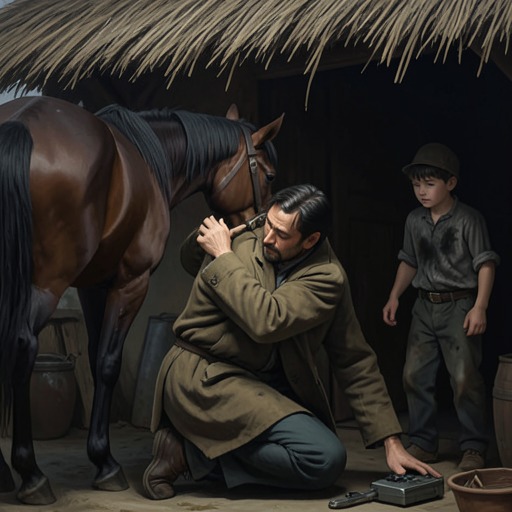
Joe’s experience gives the argument an intimate, continuing form. After Black Beauty has worked hard to bring the doctor to the household, Joe is left to care for him while John is away. Believing that the exhausted horse is too hot for a warm covering, Joe omits the blanket and gives him cold water. Black Beauty later begins to tremble and suffer, wishing for the warmth and care he had not received. When John returns, he recognizes the horse’s condition, covers him with warm cloths, and makes warm gruel for him. The contrast shows that competent care depends on knowing how an animal’s condition should be read, not simply on wishing to help.
The episode also complicates the temptation to condemn an inexperienced caregiver. Joe has done what he thought was right, and John understands that he meant no harm. Yet Black Beauty’s illness leaves Joe deeply distressed, convinced that his mistake may cost the horse his life. John is himself shaken because Black Beauty is precious to him and has saved his mistress’s life. His anger and grief are therefore not a denial of Joe’s good character; they arise from the gravity of what might happen. Thomas’s appeal prompts John to promise that he will speak kindly to the boy if Black Beauty improves. The narrative holds correction and compassion together: Joe needs to understand the danger of his mistake, but shame alone would not teach him how to care better.
Knowledge Changes What Care Can Do
The novel repeatedly sets uninformed or inattentive care against practical knowledge. In another episode, a farrier diagnoses Black Beauty’s tender feet as thrush and connects the problem to a dirty stable. He prescribes thorough cleaning of the hooves, removal of the litter each day, a clean floor, bran mashes and green food, with less corn. Black Beauty’s spirits return under this treatment. The contrast is concrete: an animal’s condition is not answered by repeated medicines alone when the surroundings and feeding that contribute to it remain unchanged. The farrier’s diagnosis turns observation into a different routine of care.
A later assessment of Black Beauty makes the same distinction between diagnosis and use. After the horse collapses under a heavy load at Ludgate Hill, a farrier says that the cause is overwork rather than disease and that six months of rest might allow him to work again, although he has no strength left at present. Nicholas Skinner rejects that course because nursing a sick horse does not suit his business; he says he works horses as long as they can go and then sells them. This is a revealing contrast with Joe’s early error. Where Joe lacks knowledge and is distressed to learn the result, Skinner has received a clear assessment and chooses economic convenience instead. Once the danger is known, ignorance cannot serve as an explanation.
From Regret to Intervention
Joe’s development shows that learning carries an obligation beyond avoiding one’s own mistakes. Later, while carrying a note on Black Beauty, he sees a heavily loaded brick cart stuck in deep mud. The horses are straining without moving it, while the carter continues to flog them. Joe tells the man to stop and offers to help lighten the cart, recognizing that the obstruction, not a lack of effort by the horses, is the immediate problem. When the carter refuses, Joe reports the abuse to Mr. Clay and agrees to give evidence if the man is brought before a magistrate.
John approves, telling Joe that cruelty and oppression are everyone’s business to challenge when they witness them. That approval marks a change in Joe: once the uncertain, inexperienced boy who had made a serious mistake in caring for Black Beauty, he now acts decisively on what he has learned. His evidence is given clearly; the horses’ exhausted condition and signs of harsh treatment support the case, and the carter is committed to stand trial. The episode broadens responsibility from personal competence to public conduct. Not knowing may call for instruction, but seeing harm and deciding that it is not one’s concern is a different failure. The narrative’s answer is practical: pay attention, learn what the situation requires, and act when knowledge reveals that help is needed.
The Principle’s Reach
Across these episodes, the novel does not collapse every harmful act into a single moral category. Joe’s mistake, the hothouse damage, and the examples John recounts arise without an intention to injure; the carter’s treatment of the trapped horses is deliberate, and Skinner persists after being told the consequences of overwork. The distinctions shape the response: a learner may need patient correction, a witness may need to give evidence, and a person who knowingly profits from harm cannot claim the protection of good intentions.
The principle is also carried by Black Beauty’s role as a narrator of bodily experience. The horse can describe what followed from mistaken care and show why a caregiver’s assumptions matter. Such testimony turns an abstract warning into a sequence of choices and consequences: a judgment about warmth, water, feeding, stable cleanliness, or work can alter an animal’s health. Responsibility, in this account, begins with acknowledging that care requires knowledge; it is completed by changing one’s conduct and refusing to leave preventable suffering unchallenged.